Understanding Mortar Firing Tables and Building Your Own
Why understanding your firing data matters more than simply having it.
When I first started shooting my own M2 60mm mortar, I did what I thought was the logical thing. I found the original military firing tables and started trying to reproduce the performance they described.
Seemed simple enough, right?
I had the gun, I had the ammunition, and I had the historical data. All I needed was to get everything to match.
Well, that turned into a much longer and considerably more frustrating year and a half long project than I anticipated.
To understand why, you need to know a little about my background. I served in the military for 23 years, but only the first eight, from 1997 to 2005, were in field artillery. The remainder of my career was in aviation.
During my artillery years, I was a surveyor, cannon crew member, gunner, and section chief. I worked on the gun line, not in the Fire Direction Center (FDC). I understood the weapons, crew procedures, fire commands, and how to execute a fire mission, but the mathematics and ballistic data behind those commands? That was somebody else's job.
When I started shooting mortars as a civilian, I discovered there was a pretty substantial gap between knowing how to operate an artillery weapon and understanding where its firing data actually came from.
And that brings us to firing tables.
What Exactly Is a Firing Table?
At its most basic, a firing table is a collection of ballistic data describing the expected performance of a particular weapon and ammunition combination under specified conditions.
That's an important distinction.
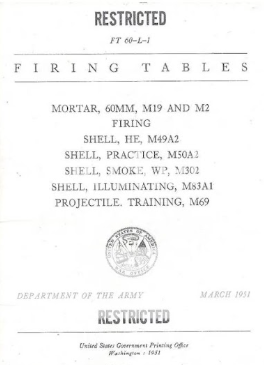
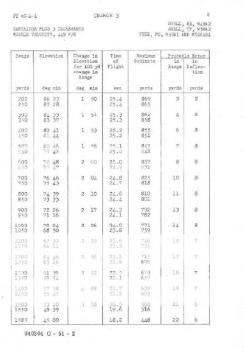
- Original WW2 era firing table for the M2 mortar
A firing table doesn't describe how every mortar in existence will perform. It describes a specific system based on a defined set of assumptions.
Historically, militaries developed firing tables through extensive ballistic research, test firing, mathematical modeling, and statistical analysis.
The United States Army established a dedicated ballistics organization at Aberdeen Proving Ground in 1918, tasked with developing firing tables, analyzing projectile trajectories, and conducting ballistic experiments.
Over the following decades, the process evolved considerably. Early tables relied heavily on physical testing and manual calculations. By the 1940s and 1950s, computers were being used to process increasingly complex ballistic information.
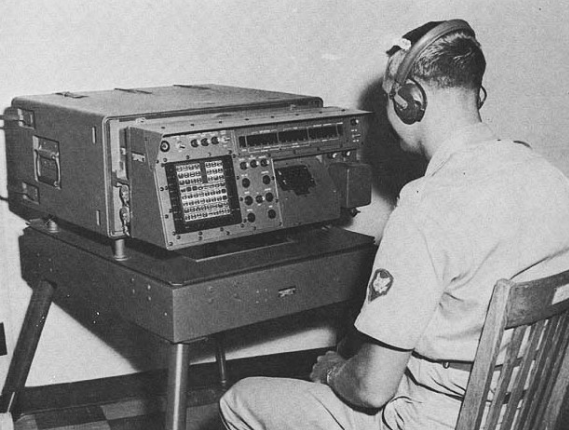
A soldier uses an early computer fire control system
Today's computerized fire-control systems are the modern descendants of that same work.
But here's something worth remembering whether you're looking at a World War II firing table or a modern digital fire-control system, the underlying information still has to represent the actual behavior of the weapon and ammunition.
The computer doesn't make bad ballistic information correct. It just processes it faster.
Understanding What You're Looking At
If you've ever opened an original military firing table without having been trained to read one, you know how intimidating it can be.
Pages of numbers, abbreviations, reference conditions, statistical information, and terminology that isn't particularly friendly to somebody seeing it for the first time.
And that's because these weren't written as introductory textbooks. They were technical references intended for personnel who had already received training in fire direction.
A few of the concepts you'll encounter include:
Standard conditions: The baseline assumptions used when developing or presenting ballistic data. These can include atmospheric conditions and characteristics of the weapon and ammunition.
Muzzle velocity: The speed of a projectile as it leaves the weapon. It's a fundamental ballistic measurement, but it doesn't tell the entire story about how consistently a system performs.
Trajectory information: Data describing the modeled or observed flight characteristics of a projectile. Historical tables contain different kinds of trajectory information depending on the weapon, ammunition, and purpose of the publication.
Dispersion: The natural variation among projectile impacts. Even with consistent equipment and conditions, individual rounds will not all follow precisely identical paths.
Probable error: A statistical way of describing variation in a particular direction. It is not the same thing as the average error or the maximum possible deviation.
Mean Point of Impact (MPI): The statistical center of a group of impacts. It helps distinguish where a group is centered from how widely the impacts are distributed.
These aren't interchangeable terms, and understanding their differences matters. We covered MPI, CEP, and dispersion in an earlier Gun Pit article, so I'm not going to repeat that entire discussion here.
What I want to emphasize is that the information contained in a firing table is interconnected. Individual numbers have meaning only within the assumptions and definitions accompanying them. A number without context isn't particularly useful.
The Historical Table Problem
Now let's get back to my M2.The historical firing tables I had were developed around military-standard ammunition and the performance characteristics associated with that ammunition.
My initial objective was to reproduce those historical characteristics with the ammunition we were developing at ODD.
We spent a considerable amount of time trying to accomplish that, and we got close, but close wasn't quite good enough, and the more time I spent trying to reproduce the historical performance, the more I began questioning whether I was approaching the problem correctly.
Eventually, I realized something that seems pretty obvious in hindsight.
I was trying to make my ammunition match the firing table, when what I really needed was a firing table that accurately described my ammunition. This is what military ordnance manufacturers do.
That was a fundamental change in how I approached the problem.
The original military firing tables weren't necessarily wrong. They were describing the performance of a particular military-standard system that was from 1940.
I was working with something different.
Why should I automatically expect identical results?
The purpose of a firing table is to describe ballistic behavior. It isn't a commandment requiring every ammunition design to reproduce the performance of something manufactured decades earlier.
What We Learned at ODD
That change in thinking became an important part of the development work that ultimately produced our M4A2 ignition charge. I'm not going to get into the construction or technical specifications of the charge here. That's not the purpose of this article.
What matters is what we learned from evaluating the system. In our testing, the M4A2 demonstrated higher measured muzzle velocity, more consistent muzzle velocity, and greater range than the original M4 configuration. Our observed impact dispersion was also smaller than the corresponding historical figures we were using for comparison. Those were encouraging results, particularly because consistency was one of our primary concerns.
There is an important qualification here, comparing modern test observations with historical reference data is not necessarily the same as conducting a controlled side-by-side experiment. Different conditions, measurement methods, and sample sizes can influence the results, but the broader lesson was clear.
We had stopped treating historical performance as the only possible benchmark and started evaluating our system on its own merits.
That gave us a much better understanding of what we were actually working with, and it changed the way I looked at firing tables altogether.
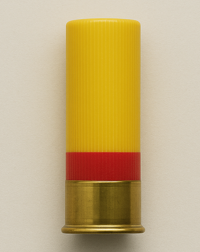
Ordnance Development Division M4A2 Ignition Charge
Can You Develop Your Own Firing Tables?
Absolutely. Firing tables are ultimately products of ballistic observation, measurement, and mathematical analysis. That's how the original tables came into existence, but there's an important difference between collecting a handful of observations and producing a firing table.
Anyone can write numbers in a notebook. That doesn't make those numbers reliable ballistic data. Proper empirical data needs to be traceable, internally consistent, and supported by enough evidence to distinguish meaningful patterns from ordinary variation. It also needs to account for uncertainty.
Consider two groups of measurements. Both might have similar averages, but one could exhibit substantially more variation than the other. If you look only at the averages, you might conclude the results are essentially identical. They aren't. That's one reason statistical concepts such as standard deviation matter. They help describe how much individual observations vary around an average.
The same principle applies to understanding the difference between velocity consistency and impact dispersion.
A system can exhibit relatively consistent muzzle velocity without necessarily producing an equally tight group of impacts. Those measurements describe different aspects of performance.
Developing a trustworthy empirical reference also requires recognizing the limits of the available evidence. Data describing one set of conditions should not automatically be assumed valid under different conditions, and importantly, developing or validating live-fire ballistic references is specialized work that requires appropriate instrumentation, qualified technical oversight, and established range-safety controls. An improvised table should never be treated as a verified firing solution.
For civilian mortar owners, the educational value is understanding what makes ballistic information credible in the first place.
How I developed my own firing tables.
I started with the knowns. I know what gun I have, an M2 60mm mortar, I know what shells I had, M69 training projectiles, and I know what the historical firing tables say they should do, this range at this elevation. It sounds like I already had all the information I needed, and I couldn't have been more wrong.
Like most mortar owners I couldn't run down to the local gun shop and pick up a box of mil-spec ignition charges. That meant I had to make my own, and here's where we get to the unknowns. I was using modern components and powders that weren't available in 1940. The performance is different and as it turns out, better, but I didn't know that, yet.
To know how far, we have to know how fast.
My first experimentation into developing my own firing table was caveman Esque. Set the elevation fire a series of shells, find the Mean Point of Impact, calculate the range back to the gun, calculate the muzzle velocity, recalculate the elevation for the range I want. It worked but it was time consuming and prone to observation and mathematical errors.
That gave me a usable firing table that was okay within reason.
Then along came the Garmin Xero C1 Pro chronograph. Now this was a game changer, suddenly I had the exact velocity of every shell, I had the standard deviation between shots, I had the exact elevation of the gun. Instead of physically finding the MPI, calculating the range back to the gun, and doing all those other steps I had the numbers in front of me. I could take the average muzzle velocity and use that to adjust my tables, and the result was considerable. The MPI and CEP tightened up and we were putting warheads on foreheads by that afternoon.
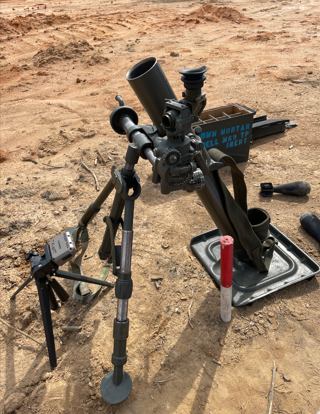
Measuring the muzzle velocity of each round with the Garmin
What about the math?
My most hated subject in high school, trigonometry. So here are the equations.
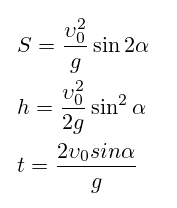
Projectile motion equations
Now here's what that means in English. The known parameters can be any combination of distance (S), maximum height (h), flight duration (t), initial angle (\alpha), and initial velocity (v_0). The equations can find the unknown parameters based on the provided known values.
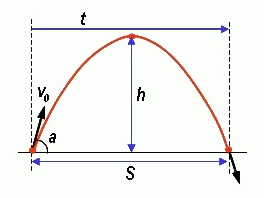
What each value in the equation represents
There's an App for that.
Remember when I said I hated math, well there's an app that runs these calculations for you, and you can thank me later.
Online calculator: Projectile Motion Calculator
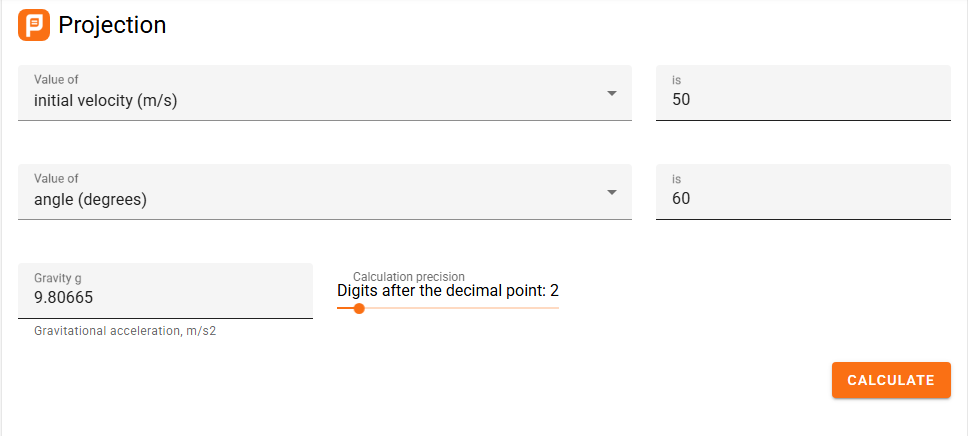

Now I can build a firing table by changing the distance and recording the angle!
If I know the average muzzle velocity and elevation of the gun the app can tell me the distance, time of flight, and the maximum altitude. Or, you don't have a chronograph. Set the elevation, fire a few rounds, determine the MPI and distance back to the gun, put that information in the app and now you have a rough muzzle velocity.
There are limitations, the app doesn't adjust for atmospheric conditions, drag effects, shell weight, or elevation above or below the target, but it'll get you close. It also won't give you the CEP, you have to go fire rounds to get that.
There's one more equation you should know. Depending on your sight it may be set up for degrees or mils. The app gives you the elevation in degrees. If your sight needs mils it can be converted.
Mils = Degrees x 17.777778
The Difference Between Historical Data and Actual Performance
I think this is probably the most important point for civilian owners of historical mortars.
Many of us are working with weapons that are 70, 80, or even more years old.
The ammunition may not have the same manufacturing history or characteristics as the original military ammunition. Components may come from different production periods, and the condition of the individual weapon may be very different from the equipment originally used in ballistic testing.
Even when two systems appear mechanically similar, that doesn't establish that they have identical ballistic characteristics.
Historical firing tables remain tremendously valuable. They document how these systems were intended to perform and preserve a substantial amount of engineering knowledge that might otherwise be lost, but historical data should be understood for what it is.
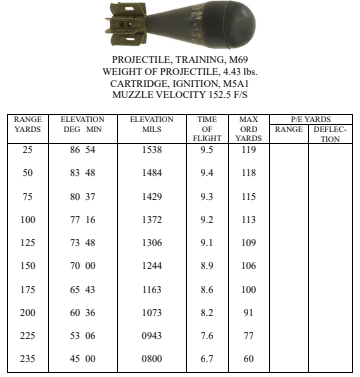
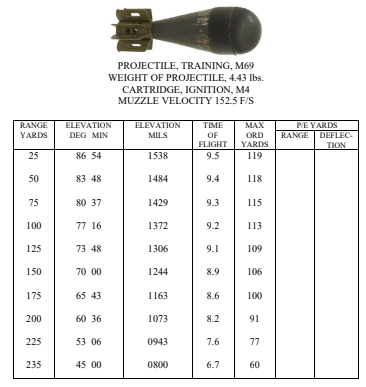
Historic firing table for the M69
It's a reference, not a guarantee.
This is particularly relevant when examining old military publications. Before placing confidence in any figure, we need to understand which system the publication describes, what assumptions were used, and what limitations accompanied the original data, and none of that should be interpreted as permission to substitute unverified ammunition or use unvalidated data in live firing. Historical documentation is not a substitute for a modern safety assessment.
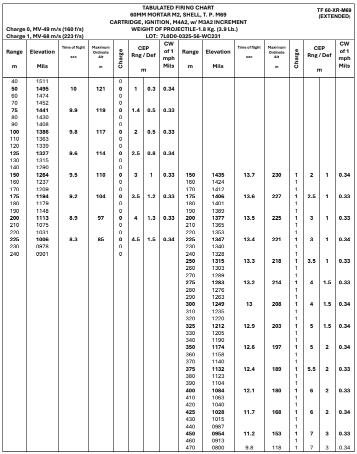
ODD's firing table for the M69
The Gun Line and the FDC
Looking back at my own military experience, I find this entire subject particularly interesting.
For eight years, I worked in field artillery without needing to understand how firing tables were developed.
That wasn't a failure of my training. I was trained to perform a specific job, and the military divides responsibilities among people who specialize in different parts of the process.
The gun crew operated the weapon. The FDC handled fire direction. Together, they formed a system.
As a civilian mortar owner, I found myself having to understand parts of that system that I'd never been responsible for before, and even after years of artillery experience, there was still plenty I didn't know.
That's something I think gets overlooked in the civilian mortar community.
Military experience is valuable, but not everybody who served in an artillery unit received the same training. A gunner, section chief, forward observer, and fire direction specialist all bring different knowledge to the table.
Understanding where those areas of expertise overlap, and where they don't, is part of becoming a more knowledgeable shooter.
There's no shame in not knowing something.
The problem is assuming you understand something you haven't actually studied.
The Takeaway
If there's one thing I want readers to remember, it's this.
A firing table is a representation of ballistic performance, not an immutable law of physics.
It reflects a specific system, a set of assumptions, and the evidence available when it was developed.
The historical tables we have today are remarkable documents. They represent generations of research, engineering, mathematics, and practical experience, but understanding them requires more than simply reading the numbers.
It requires understanding what those numbers represent, why they were recorded, and where their limitations begin.
My own experience taught me that lesson through a lot of frustration, testing, and occasionally questioning whether I was chasing the wrong objective entirely.
As it turned out, I was. Once I stopped trying to force our equipment to reproduce a historical benchmark and started looking critically at what the evidence actually demonstrated, the entire subject of firing tables began to make a lot more sense, and that's really the point.
You don't have to be a ballistician to appreciate the science behind gunnery, but you do need to recognize the difference between knowing what the book says and understanding why it says it.
Because sometimes the most important thing you can learn from a firing table isn't the number printed on the page.
It's what that number actually means.