Fire Direction Control for the common man.

To know where you're going, you've got to know where you are.
Gunnery in its simplest form is making triangles. If you can draw a triangle, you can calculate a firing solution.
Outside of special circumstances, most civilian mortar owners are going to be firing direct. You can see the target from the gun and align the sight on it. That only gives you so much information about what's going on in the space between the gun and the target.
Even firing direct, there's a lot of physics, geometry, and trigonometry happening. So how do we solve those problems?
"Charts and Darts"
The science behind gunnery hasn't changed. We just have better tools now, like digital fire control systems, but the old plotting method still works and we still use it.
The primary method for charts and darts is a plotting board like the M16, M19, or ODD's P12A1.
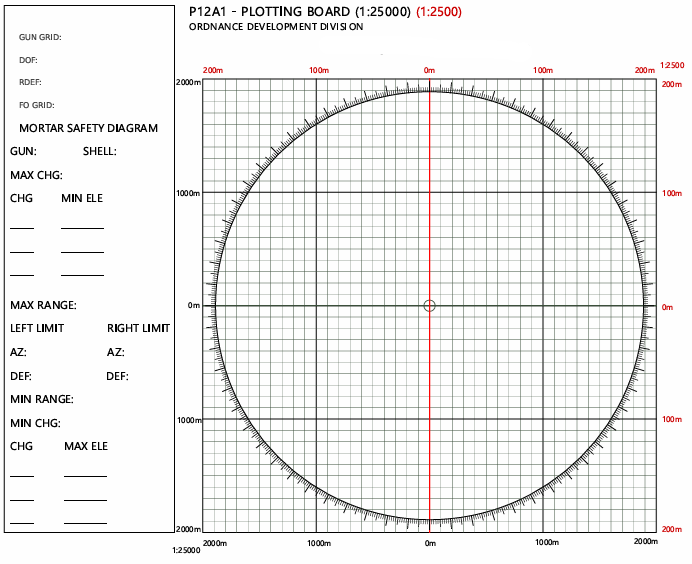
In a nutshell, a plotting board turns a geometric math problem into a visual one. Even though the concept and use of plotting boards dates back to before WW1 we still use them, because they work when everything else fails.
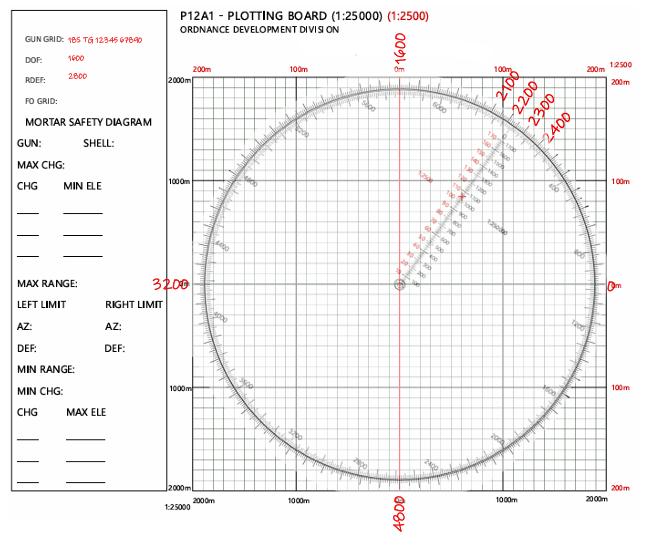
Plotting boards are kind of hard to find, not many made it to the public because of military controls on them, and you need the training and knowledge to use one effectively.
Civilian shooters usually don’t have access to that equipment or training, so the field-expedient alternative is the map spot.
"The Map Spot"
The map spot is a field-expedient way of calculating the direction of fire, gun target line, and deflection. For a map spot you're going to need a few things.
A map, not just any map, you need an MGRS grid map. I recommend a 1:2500 for a civilian shooter.
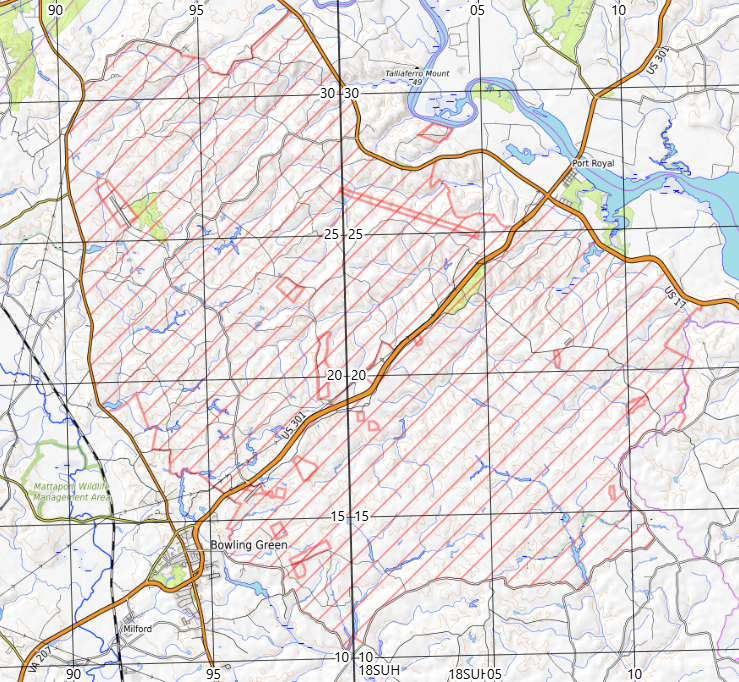
Then you're going to need a plotting protractor. One that has mils, distance scales, and grids.
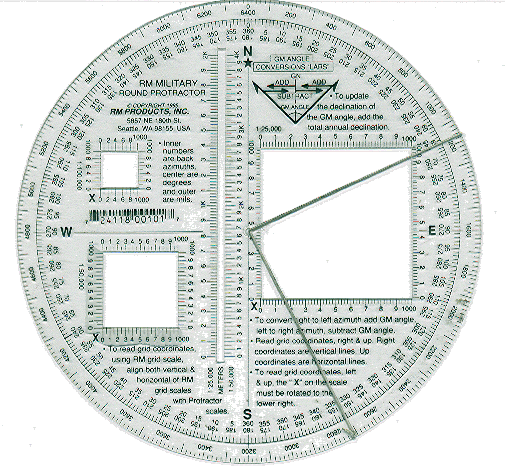
And finally you're going to need a compass. Again, something that has mils.
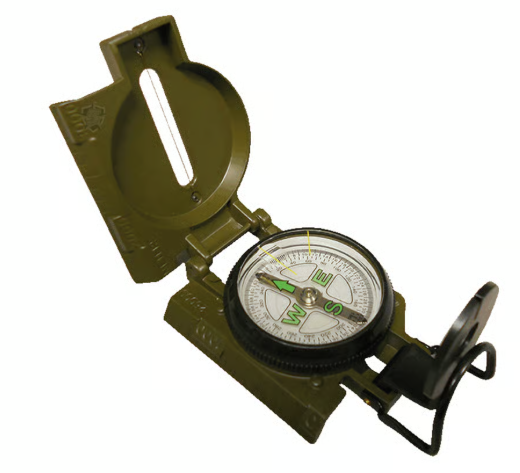
Without turning this into a class on land navigation, you are going to use these three tools to find the location of the gun, the target, and the grid azimuth from the gun to the target.
The azimuth that gun is initially laid in on is the Direction of Fire or DOF
The azimuth from the gun to the target is the Gun Target Line or GTL.
The angular difference between the DOF and the GTL is the deflection.
Using the GTL and the protractor, measure the range from the gun to the target.
Now we know the grid azimuth to the target and the range.
Now, these are not precision instruments; with a map spot the best accuracy you can hope for is + 40 mils and + 20 meters. However, for a civilian shooting at ranges under 500 meters, that's good enough to get you within one or two adjustments.
That's the darts, what about the charts?
"Tabulated Firing Chart"
For the civilian shooter, this is probably going to be the most useful piece of information you can have.
Service ammunition is issued with a firing chart. These charts really don't exist outside of the military and for the civilian shooter they wouldn't be correct anyway. That's the reason the ODD has its own firing charts, and you should too.
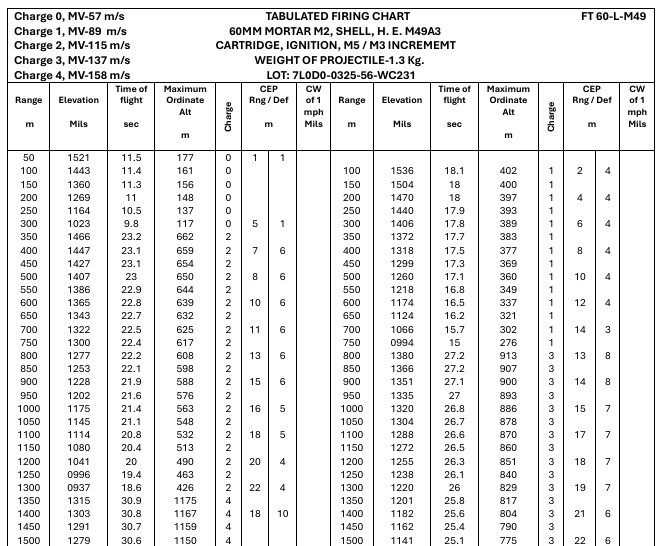
A firing chart can be tabulated like the one above and contain a lot of data, or it can be as simple as the one below.
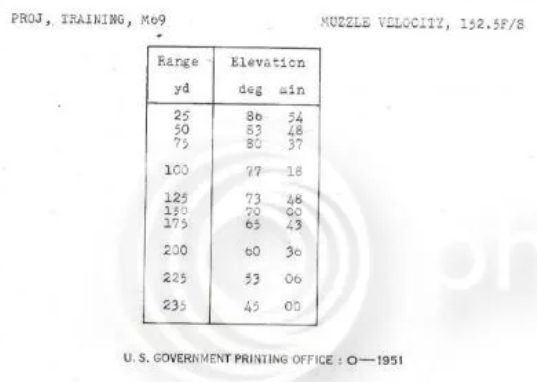
A firing chart should have at a minimum the range, elevation, and charge if using increments in an easily readable format.
Think of this chart like a DOPE (Data On Previous Engagements) book.
Every gun, shell, charge, weather condition, and firing position behaves a little differently. That’s why experienced gunners continuously refine their charts with observed data.
"What Happens Down Range"
Mortars exist in a sort of accuracy grey area. They aren't precision weapons but they aren't quite area weapons either. It's to whom it may concern.
Two terms you need to know.
Circular Error Probable or CEP.
Mean Point of Impact or MPI.
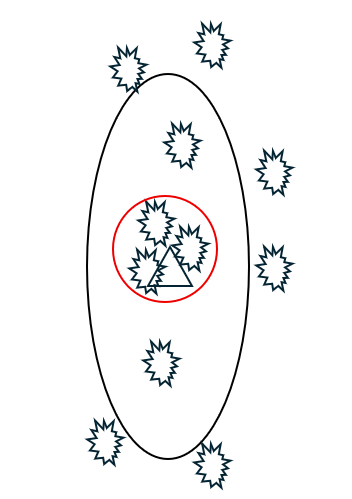
First, we'll talk about CEP. CEP is just statistics. It states that 50% of impacts will occur within a certain distance of the target while 50% will impact outside of that distance. The further the range from the gun to the target the larger the CEP will become.
Then there's MPI. The MPI is the center of the impacts and what we use to make aiming adjustments.
CEP and MPI are just facts that we have to deal with. In gunnery dispersion of impacts is normal.
"Final Thoughts"
The biggest thing to understand about fire direction control is that it does not exist to make mortars “perfect.”
It exists to make them predictable. That’s the goal. You are taking a weapon system that naturally produces dispersion, environmental effects, ammunition inconsistencies, and human error, then using math, observation, and procedure to reduce the chaos as much as possible.
Even the military still relies on adjustments, corrections, and observed fire. That’s normal. Good gunnery is not about landing every round exactly on the aiming point. Good gunnery is about understanding what the gun is doing, understanding why it’s doing it, and making intelligent corrections.
That’s where charts, maps, plotting boards, and firing data come in. They are tools that help you understand the relationship between the gun, the terrain, and the target, that’s the part a lot of civilian shooters miss.
Mortars are not just oversized launchers. They are indirect fire systems. The interesting part is not simply making the round go off. The interesting part is learning how to place rounds where you want them consistently and safely.
The good news is you do not need a full Fire Direction Center, a stack of military equipment, or a room full of specialists to start learning the fundamentals. A map, a compass, a protractor, a firing chart, and a basic understanding of geometry will take you surprisingly far.
Because at the end of the day, gunnery is still just solving triangles.
The tools may change. The technology may improve.
But the fundamentals are still the fundamentals.