The Forward Observer: More Than Just Calling for Fire
When most people hear the term Forward Observer, they immediately picture a soldier in a concealed position or sitting on a hill somewhere with binoculars and a radio, calling artillery onto a target he can see but the guns cannot.
That's not wrong.
It's just incomplete.
In military operations, the Forward Observer, or FO, is part of the fire-support system. His job includes locating targets, observing fires, communicating information back to the firing unit, and helping turn what is happening at the target into useful information for the people delivering the fires. Army doctrine describes the FO as the fire-support representative at the maneuver level, with the primary responsibility of accurately locating targets and observing and adjusting supporting fires.
But this is The Gun Pit, not Infantry Officer Basic Course, and most civilian mortar owners aren't supporting a platoon attack.
Most of us are shooting direct fire. The gun can see the target. So why would a civilian mortar crew need a Forward Observer? Because being able to see the target does not mean the gun crew can see everything that matters.
Before Somebody Calls Me a 13F
I'll get this out of the way now. I am not a 13F, and I've never claimed to be one.
My military indirect fire background was as an 82C and 13B, and the formal Forward Observer training I received was limited to what was required for that job. I've worked around indirect fire, understand the basic observer process, and have spent a lot of time applying those concepts to civilian mortar gunnery, but I'm not going to pretend that makes me a career Fire Support Specialist.
If you want to learn how to be a Forward Observer, there are people considerably more qualified than I am to teach you, and we have them in our instructor cadre.
That isn't what this article is about.
This article is about why the observer function has value to the civilian mortar owner, even when the gunner is looking directly at the target.
And it has a lot of value.
The Gun Crew Has a Job
One of the mistakes I see in civilian mortar shooting is the gunner to doing everything.
Lay the gun. Setting the sight. Watch the bubbles. Watch the gun. Load and fire. Watch the target. Watch the impact. Figure out what happened. Decide what to do next.
That's a lot of information for one person to process, and if it sounds like task saturation, that's because it is and nothing good comes from it.
A properly functioning mortar crew should be concentrating on the weapon. Did the gun move? Did the baseplate settle? Is the sight still where it should be? Did the crew properly apply the firing data? Is the weapon behaving normally? Those are gun-line problems.
Meanwhile, something else is happening several hundred meters away. That's the observer's problem.
Somebody Needs to Watch the Other End
The Forward Observer gives the mortar crew something extremely valuable:
A dedicated set of eyes on the impact area. That sounds obvious, but it fundamentally changes the quality of information coming back to the gun. The gunner sees the world from the firing point. The observer sees the world from a safe distance in the impact area. Those aren't the same perspective.
Depending on terrain, vegetation, lighting, dust, distance, and the relationship between the firing point and the target, an impact that appears obvious from one position may be difficult to interpret from another.
I've stood behind mortars and watched a round disappear downrange only to have everybody on the gun line ask, including myself the same question. “Where the hell did that go?” Meanwhile, somebody positioned to actually observe the impact may have had no trouble seeing it. That's the value of different perspectives.
Direct Fire Doesn't Make the Observer Unnecessary
Most civilian mortar firing is going to be direct fire simply because that is the practical reality of the ranges available to us. We generally aren't sitting behind a hill engaging something we can't see, but there is a misconception that direct fire eliminates the need for an observer. It doesn't. Direct fire simply means the gun can see the target. The mortar is still producing a dispersion pattern. The ammunition is still subject to variation. The environment is still affecting the round. The weapon is still settling and moving. And the person operating the mortar is still busy operating the mortar. The fact that the gunner can physically see the target doesn't suddenly give him a better view of what is happening around it. In many cases, it gives him a worse one.
Watch the Pattern, Not the Round
This ties directly into something we've already discussed in The Gun Pit: dispersion. Mortar rounds do not all land in the same hole. They form a pattern. That means the observer's job isn't simply to announce where the last round landed. The useful information is what the pattern is doing. One round goes a little left. The next goes a little right. The third lands short. If we start changing the gun every time an individual round isn't exactly where we expected it to be, we're going to spend the entire afternoon chasing random dispersion around the impact area, and no one is having fun.
That's not gunnery. That's reacting emotionally to individual impacts. A good observer helps prevent that. Instead of becoming fixated on one round, the observer watches what happens over time. Where does the pattern appear to be centered? Is it consistently displaced? Is the dispersion behaving normally? Did something suddenly change?
Those observations help the crew distinguish between an individual round doing what statistics say individual rounds occasionally do and an actual trend developing in the system.
That is exactly why concepts like Mean Point of Impact matter. One impact is information. A pattern is data.
The Observer Completes the Feedback Loop
Think about mortar gunnery as a feedback loop. The gun crew establishes firing data. The mortar fires. The round impacts. Somebody observes the result. That information comes back to the crew. The crew determines whether anything needs to change. Then the process repeats. Without reliable observation, part of that loop is missing. The crew knows what it told the gun to do. It doesn't necessarily know what actually happened at the target. That's an important distinction. The observer closes that gap. This is true whether you're conducting military indirect fire or shooting a registered M2 at a target on private property. The scale and purpose are different. The basic information problem is the same.
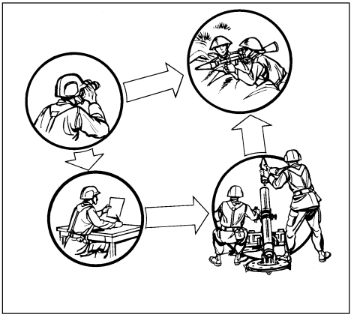
The military indirect fire team and the information loop
The FO Is Also a Safety Asset
For the civilian mortar owner, this may be even more important than adjusting impacts. An observer gives you another person whose attention is directed toward the impact area rather than toward the weapon. That does not make the Forward Observer the Range Safety Officer. Those are different responsibilities. But an observer can provide another layer of situational awareness. If something doesn't look right downrange, somebody should be watching closely enough to recognize it.
An unexpected or unobserved impact. A vehicle or person entering an area they should not be in. A change in conditions. Something occurring near the limits of the impact area.
Those are exactly the kinds of things you want communicated immediately rather than discovered after the next round has already left the tube.
At ODD, we approach live fire with the assumption that multiple layers of observation are better than one when we teach direct and indirect fire. Our FOs are a part of the process all the time and I'm always more comfortable with more than one watching the impact area. One can be locating targets while the other is observing impacts and adjusting fires, or if conditions are marginal, we may have both FOs observing impacts and adjusting.
The Observer Doesn't Tell the Gunner What He Wants to Hear
This is another important point. An observer's job is to report what he sees, not what he believes should have happened. That sounds simple. It isn't always. People have an enormous tendency to interpret information in ways that confirm what they already believe. If the gunner expects the round to land in a particular location, everybody watching has a tendency to look there.
Then somebody sees dust. “That's it.” Maybe. Maybe not. A good observer avoids filling in missing information. If he didn't see the impact, he didn't see the impact. If he isn't sure what happened, he says he isn't sure. Guessing introduces bad information into the system, and bad information can be worse than no information at all.
Computers have a saying for this. Garbage in, garbage out. Mortar gunnery works exactly the same way.
Communication Matters More Than Fancy Equipment
The military observer and ODD have access to equipment and communication systems that most civilian mortar owners simply aren't going to have. That's fine. You don't need an entire Fire Support Team to apply the principle.
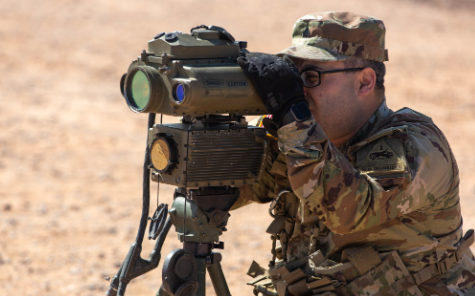
Military GPS equipped laser range finders like the LLDR 2H makes target location faster and more accurate.
The civilian observer needs to be able to clearly see the impact area, understand what he's looking at, and communicate clearly with the gun crew. The equipment can be remarkably simple, binoculars, a range finder, and a radio.
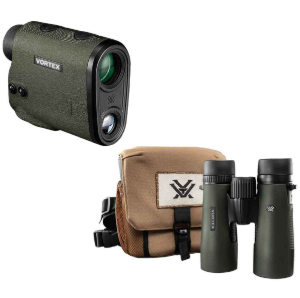
For the civilian FO a good set of binos and a laser range finder will work just fine.
What's important is that everybody understands the information being passed. This is one of the reasons standardized terminology matters. Not because civilians need to cosplay military procedures, but because ambiguous language wastes time and creates misunderstandings.
“Over there.” “A little bit left.” “About that much.” “Pretty close.” None of those statements mean very much. Good communication should reduce uncertainty rather than add to it.
You don't have to use the Army's exact verbiage, your crew can develop its own, as long as everyone understands what's being said and what needs to be done, and that can be more effective than everyone trying to learn the military call for fire and what it means.
The Observer Is Extremely Valuable During Testing
For us at the Ordnance Development Division, the observer becomes particularly useful during testing.
When we're evaluating ammunition, charges, weapon behavior, or firing data, we aren't simply interested in whether a projectile made it downrange. We want to know what the system did.
That means somebody needs to watch the system from the other end. Where are the impacts occurring? What does the dispersion look like? Is there an identifiable pattern? Did the behavior change as firing continued? Are the observed results consistent with the firing data?
The gun crew can't effectively operate the weapon and independently collect all of that information at the same time, there's that task saturation thing again.
This is why separating responsibilities improves the quality of the data. The gun crew worries about the gun. The observer worries about the impacts. Afterward, we put those two sets of information together. That's when you start learning something.
It Also Makes Better Gunners
There is another benefit that isn't immediately obvious. Spending time as an observer makes you a better gunner. You begin to understand what mortar dispersion actually looks like from the receiving end. You stop treating every odd impact as a failure. You begin recognizing patterns. You understand why corrections need to be based on useful observations instead of emotion. You gain an appreciation for how small changes at the gun can appear much larger downrange, and perhaps most importantly, you learn that what looks obvious from one end of a mortar range may look completely different from the other.
Every member of a serious mortar crew should spend time observing. Not because everyone needs to become a 13F or even be proficient at observing and adjusting. Because everyone benefits from understanding the complete system.
Civilian Mortar Gunnery Is Still Gunnery
This is one of the recurring themes in The Gun Pit. Civilian mortar ownership tends to focus heavily on the hardware. The mortar. The sight. The ammunition. The charges. All of those things matter, but they aren't the complete weapon system. The people operating the equipment are part of the system too. So is the person watching the impacts. The military didn't develop Forward Observers because somebody thought radios, binoculars, and GPS equipped range finders looked cool.
They exist because indirect fire creates an information problem. The people firing the weapon and the people observing its effects are often looking at the same event from completely different perspectives. Civilian mortar firing may simplify that problem considerably, particularly when we're firing direct. It doesn't eliminate it.
You Don't Need to Be a 13F to Understand the Principle
I am never going to claim that somebody reading this article is now trained as a Forward Observer.
You're not.
Neither am I.
Real FO training involves considerably more than what can or should be covered in a blog post, but civilian mortar owners don't need to recreate an entire military fire-support organization to learn something from it. The principle is simple. Give somebody the job of watching where the rounds are landing. Learn what normal dispersion looks like and teach them to recognize trends instead of chasing individual impacts. Teach them to communicate clearly. Teach them that saying “I don't know where that round went” is infinitely more useful than inventing an answer and make sure they understand that safety always overrides the desire to keep shooting. That alone will improve a civilian mortar crew considerably.
The Gun Fires. The Observer Sees.
The mortar tells you something every time it fires. The gun crew gets one part of that information. The observer gets another. Good gunnery happens when those two pieces come back together. That's really the Forward Observer's value to the civilian mortar owner. He isn't there simply because the gun can't see the target. He's there because the gun crew shouldn't have to watch everything at once. A mortar fires at one end, and the impact happens at the other. Somebody needs to be paying attention.