
Mortar Accuracy: Understanding CEP, Probable Error, and Dispersion Without a Statistics Degree

When most shooters hear the word accuracy, they immediately think about group size.
That makes sense. Rifle shooters spend their entire lives measuring accuracy in inches, minutes of angle, or increasingly milliradians. Five shots go into a nice little cluster, somebody pulls out a ruler, and a judgment is made about the rifle, the ammunition, the shooter, or all three.
Mortars don't work that way.
A mortar is an area-fire weapon, "to whom it may concern" and the language used to describe its accuracy reflects that. One of the most common terms you will encounter in military manuals, ballistic data, test reports, and discussions of indirect-fire systems is CEP, or Circular Error Probable.
The name sounds more complicated than the concept really is.
So, What Is CEP?
In simple terms, CEP describes the expected dispersion within a group of impacts around a central point.
Imagine firing a large number of identical rounds under the same general conditions using the same firing data. The rounds will not all strike the exact same location. Instead, they will form a pattern.
Now imagine determining the center of that pattern and drawing a circle around it. In reality it's more of an oval oriented on the Gun Target Line, but for the sake of the math we say it's a circle.
The radius of the circle that contains approximately 50 percent of the impacts is the CEP. That is the basic idea.
If a weapon system is described as having a CEP of a certain distance, it does not mean that every round will land within that distance. It means roughly half of the rounds in a sufficiently large sample would statistically be expected to fall inside that radius around the center of the impact pattern. The other half fall outside it. That last part is important, and this concept applies to artillery and aerial ordnance too.
CEP is frequently misunderstood as a maximum-error measurement. It is not. A round landing outside the CEP circle has not automatically done anything abnormal. Some impacts will naturally land farther from the center than others. CEP describes probability, not a hard boundary.
Accuracy and Precision Are Not the Same Thing
This is where terminology starts mattering. A weapon can be precise without being accurate, and it can also be reasonably accurate while showing greater dispersion.
Suppose a mortar fires several rounds that land very close together, but the entire group is displaced significantly from the intended point.
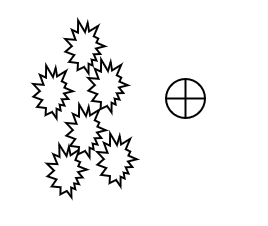
That is a precise group. It just happens to be in the wrong place.
Now imagine another group that is somewhat wider but distributed around the intended location.
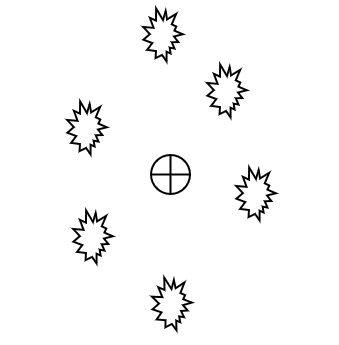
That is a wide group, but it's in the right place.
Those two situations tell you very different things about the weapon system.
The first group tells us we need to adjust our point of aim, the second tells us other factors may be in play. Nether one is bad they just give us different information.
In ordinary shooting conversation, people frequently use the word accuracy to describe both concepts. In indirect fire, separating them becomes much more useful. Precision deals with how consistently the rounds behave relative to one another. Accuracy deals with where the center of that pattern lies relative to the intended location. CEP primarily helps us describe the dispersion around that center.
A Mortar Pattern Is Not a Rifle Group
One of the biggest conceptual adjustments for someone coming from the small-arms world is accepting that mortar impacts form a dispersion pattern rather than what we normally think of as a group.
Don't think of a mortar like a rifle, it's a shotgun that fires one pellet at a time. Dispersion exists even when nothing is wrong. There are many small variables involved in firing any projectile, and no two events are perfectly identical.
The ammunition will vary slightly from round to round. Environmental conditions are constantly changing. The mortar settles in between rounds. Components wear. Manufacturing tolerances exist. Small differences accumulate.
With a rifle firing a relatively high-velocity projectile at comparatively short distance, some of those variables may have a limited opportunity to influence the final impact point.
A mortar projectile spends substantially more time in flight. For example, a rifle might fire a projectile at 2700 feet per second at a target 300 yards away, where a mortar might fire a projectile at 150 feet per second at the same range. The mortar shell is going to take significantly longer to get there.
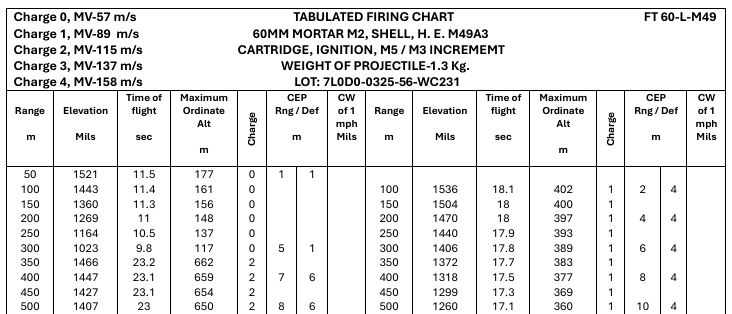
A sample of the M49A3 Firing Chart showing time of flight and CEP in range and deflection.
Small differences therefore have more opportunity to become visible at the target. This does not make mortars inherently inaccurate. It means their accuracy has to be evaluated according to the type of weapon they are, an area weapon.
Trying to judge a mortar the same way you would judge a match rifle is like criticizing a dump truck because it cannot corner like a sports car. The comparison ignores what each machine was designed to accomplish.
The Center Matters More Than Any One Round
Another mistake is judging the performance of the entire system from a single impact. One round tells you where one round landed. It does not necessarily tell you where the center of the weapon's dispersion pattern is. This becomes important because human beings are very good at noticing dramatic results. A round landing unusually far from the others immediately gets attention. So does a round that happens to strike extremely close to the desired point.
Neither result, by itself, necessarily tells you very much about the overall behavior of the system. Patterns require samples. The more observations you have, the clearer the underlying behavior becomes.
This is one reason concepts such as mean point of impact, often abbreviated MPI, are useful when discussing indirect-fire accuracy.
The MPI represents the statistical center of a group of impacts. CEP then describes how those impacts are distributed around that center.
Put another way: MPI tells you where the pattern is. CEP tells you something about how spread out the pattern is.
That distinction is much more useful than simply identifying which individual impact landed closest to the desired location. As mortar crews we can adjust the Mean Point of Impact, we cannot eliminate the inherent dispersion of the system, we just have to accept it as part of the equation.
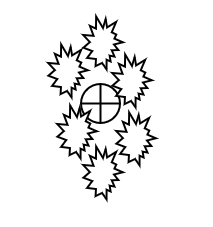
The Mean Point of Impact for this group
Dispersion Is Not Automatically Error
This distinction is particularly important for civilian mortar owners. Normal dispersion should not automatically be interpreted as a problem with the gun, ammunition, sight, or crew. Every ballistic system has dispersion. What matters is whether the observed dispersion is consistent and reasonable for the system being used.
If the entire pattern shifts consistently in one direction, that may indicate something different from ordinary random dispersion. Likewise, if a previously consistent system suddenly produces dramatically greater spread, that tells you something different again.
The important lesson is that random dispersion and systematic error are not the same thing. Random dispersion tends to scatter impacts around a central point. Systematic error tends to move the central point itself. Understanding that difference prevents a lot of bad conclusions.
As The Range to the Target Increases the Dispersion Increases.
A concept that rifle shooters will recognize is the increase in dispersion as the range increases. With rifles that's measured in mils or MOA. In mortars it's measured in yards or meters. Here is where mortar terminology gets a little more precise. Because a mortar's dispersion pattern is normally elongated along the gun-target line, firing tables don't necessarily give us one neat circular CEP number. Instead, they may give us Probable Error in Range and Probable Error in Deflection. For the M49A3 at 300 meters at charge 1, our chart data gives us 6 meters in range and 1 meter in deflection. At 1,000 meters, those values increase to 15 meters in range and 7 meters in deflection.
So what does that really look like?
Circular Error Probable, CEP = one radius describing a 50% circle.
Probable Error range, PEr = 50% probability interval along the gun-target line.
Probable Error deflection, PEd = 50% probability interval laterally.
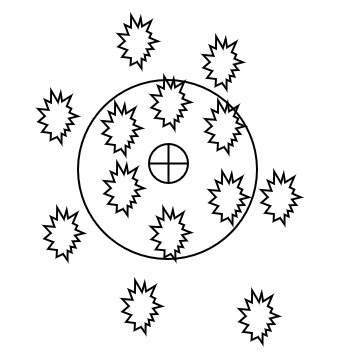
CEP as a whole number
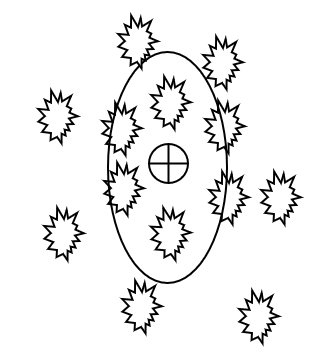
Range dispersion, PEr
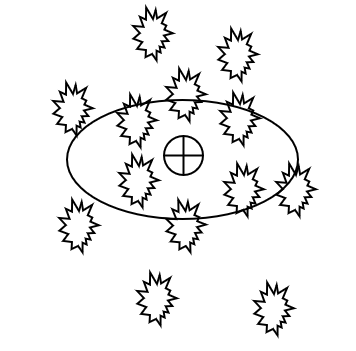
Deflection dispersion, PEd
Why is this important for civilian mortar shooters? Because wider dispersion can equal lost rounds on a good day and rounds impacting something or somewhere we don't want them too on a bad day. It's a safety thing. Dispersion is something we just have to accept. The important thing to remember is that these are two separate probability statements. PEr tells us about dispersion along the gun-target Line, while PEd tells us about lateral dispersion.
Neither value represents a hard boundary, and neither means that all, or even 50 percent, of the rounds must fall inside an ellipse drawn using both values. It's not a hard limit. It's a statistical estimate based on observed weapon and ammunition performance.
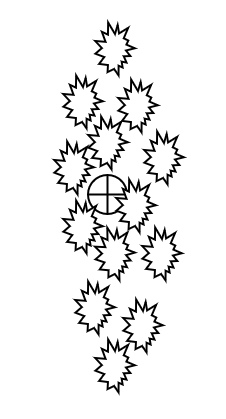
PEr and PEd, what normal dispersion looks like in reality
Why 50 Percent?
This is usually the point where somebody asks the obvious question.
Why does CEP only describe 50 percent of the rounds? Why not 90 percent? Or all of them?
The answer is that CEP is a statistical convention.
Using the 50-percent probability radius provides a standardized way to compare the dispersion of different systems without pretending there is a hard outer boundary around the impacts. Real dispersion patterns do not suddenly stop at a convenient circle.
As you move farther from the center of the pattern, the probability of finding impacts generally decreases, but it never becomes a perfectly clean cutoff. This is why saying that a weapon has a particular CEP does not mean twice that distance contains every possible impact. Statistics do not work that neatly. CEP is simply one useful way of describing the probability distribution.
The Dartboard Example
The easiest way I have found to explain this is with a dartboard. Imagine throwing 100 darts while aiming at the center. You are not going to put all 100 darts through the exact same hole. Instead, you will create a pattern.
Most will cluster somewhere near the center. Some will land farther away. A few may land considerably farther away than the majority.
Now determine the average center of all those impacts. That becomes your equivalent of the mean point of impact.
Next, draw a circle around that center large enough to include 50 of the 100 darts. The radius of that circle is essentially what CEP is describing.
A dart outside the circle is not necessarily a bad dart. It is simply part of the overall statistical distribution. The same principle applies to mortar impacts.
What CEP Does Not Tell You
CEP is useful, but it does not tell you everything about a weapon system. It does not tell you why dispersion exists. It does not tell you whether the center of the pattern is where you wanted it. It does not tell you whether one particular round was defective. It does not tell you whether the crew did something wrong. And it certainly does not represent a guaranteed maximum distance from the desired point. CEP is one piece of information. It becomes meaningful when combined with other observations about the weapon, ammunition, environment, and overall firing process. That is why serious gunnery is a system rather than a collection of isolated numbers.
Stop Chasing the Best Round
There is also a psychological lesson here. Shooters naturally become excited about the round that lands closest to the desired point. It feels like success.
But from an evaluation standpoint, the round that happens to land closest to the center may be no more informative than one that lands farther away.
What matters is the behavior of the complete pattern. A good indirect-fire system is not one that occasionally produces a spectacularly centered impact.
It is one whose behavior is repeatable, understandable, and predictable enough that the people operating it know what the observed impacts actually mean. That requires looking beyond individual rounds.
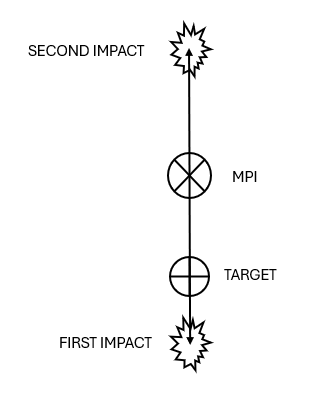
The first round hit near the target the second went long. The MPI is long of the target.
Why Civilian Mortar Owners Should Understand CEP
Civilian mortar ownership occupies an unusual corner of the NFA world. The guns are available. Original manuals are available. Training ammunition exists. What is often missing is the institutional knowledge explaining how all of those pieces fit together. Without that background, it is easy to apply familiar small-arms concepts to a weapon system that operates according to a very different set of assumptions.
CEP is a good example.
Someone accustomed to rifles may look at several mortar impacts spread across an area and conclude that the weapon is inaccurate. A mortarman looks at the same pattern and asks different questions.
Where is the center? How large is the dispersion? Is the pattern behaving consistently at the given range? Those questions are much closer to understanding what the weapon system is actually doing.
How the Ordnance Development Division Plans Fires around Dispersion
We don't do anything without a plan especially live fire. Fortunately, those military manuals give us the answers. For every live fire we make a safety diagram. Instead of it just being numbers written down we have a visual representation of what we expect to happen down range. Our training sites impact areas are small compared to military impact areas, some are only 100 meters by 300 meters. PEr and PEd are part of that evaluation, not the safety boundary themselves. Our safety planning accounts for the larger dispersion pattern and appropriate safety margins before deciding whether a target can be engaged from a particular position.
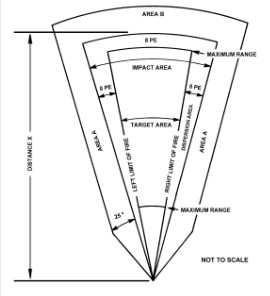
Illustration of a Safety Diagram
We may decide not to fire on that target at all, or we may decide that it can't be fired on from our current gun position, or the predicted dispersion and safety margins are acceptable from a different position, then it becomes a question of risk management and mitigation.
Mortar Accuracy Is About the Pattern
The easiest way to remember all of this is simple. A rifle shooter tends to think about the individual shot. A mortarman has to think about the pattern. CEP gives us a standardized way to describe part of that pattern. MPI gives us a way to adjust that pattern onto the target. It does not eliminate uncertainty, and it does not predict exactly where the next round will land. That is not what it is intended to do. It gives us a statistical description of dispersion and the center of a group.
And once you understand that, mortar accuracy stops looking like a bad rifle group and starts looking like what it actually is. The predictable behavior of an indirect-fire weapon system.